BC Assessment vs. Market Value: Why They’re Rarely the Same
Every January, homeowners across British Columbia receive their BC Assessment notice. And every year, the same question comes up:
“Is this what my home is worth?” The honest answer? Not necessarily.
BC Assessment values and market value are related, but they are not the same thing. And when you look at real-world sales, the gap between the two becomes very clear.
What BC Assessment Actually Represents
BC Assessment values are primarily used to calculate property taxes. They’re based on an estimated market value as of July 1st of the previous year, using mass appraisal models and broad market data.
That means:
- The number is already six months old when you receive it
- It cannot reflect current buyer demand
- It doesn’t fully account for condition, presentation, or buyer emotion
Assessments are a reference point, not a pricing strategy.
What Market Value Really Is
Market value is determined in real time, when a willing buyer and seller agree on a price today. It’s shaped by:
- Supply and demand
- Buyer competition
- Property type
- Location and lot characteristics
- Condition, layout, and updates
- Presentation, marketing, and negotiation
This is why two homes with similar assessments can sell for very different prices, and why assessment values often fail to predict the final sale price.
Real Examples: Homes Selling Below Assessment
Let’s look at a few real-life examples:
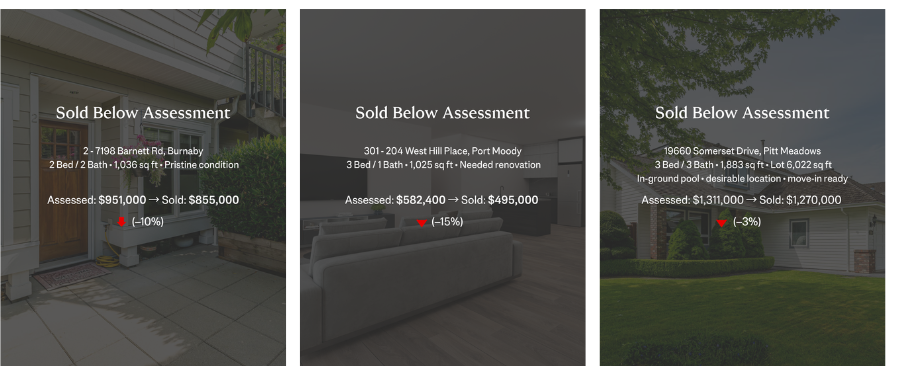
2-7198 Barnett Road in Burnaby is a well-kept, move-in-ready condo in a great location. No renovations were needed and it came with high-end finishes. Despite this, the home sold $96,000 below its assessed value.
This is a perfect illustration of an important point: even strong, well-presented homes can sell under assessment when buyer demand in that segment softens.
Another example is 301 - 204 West Hill Place in Port Moody, which required renovating. While renovations certainly influenced buyer interest, the final sale price still highlighted a broader point, the assessment did not reflect current market conditions, particularly for attached properties.
Finally, 19660 Somerset Drive sold slightly below assessment, despite being a desirable home. While this property had unique characteristics, including a smaller footprint and a pool (which can sometimes limit buyer appeal), it again reinforced the same theme: assessment values don’t guarantee what a buyer is willing to pay.
A Clear Pattern Emerges
When reviewing the data as a whole, a consistency becomes apparent:
- Attached properties (condos and townhomes) tended to sell at or below assessment
- Detached homes, with one exception, sold above assessment
This doesn’t mean one property type is “better” than another. These are simply different products, serving different buyers, and responding differently to market conditions.
A buyer shopping for a condo is usually not choosing between a condo and a detached home. They’re operating within a specific price range and lifestyle preference. As a result, shifts in demand affect these segments in very different ways.
Homes Selling Above Assessment: Demand in Action
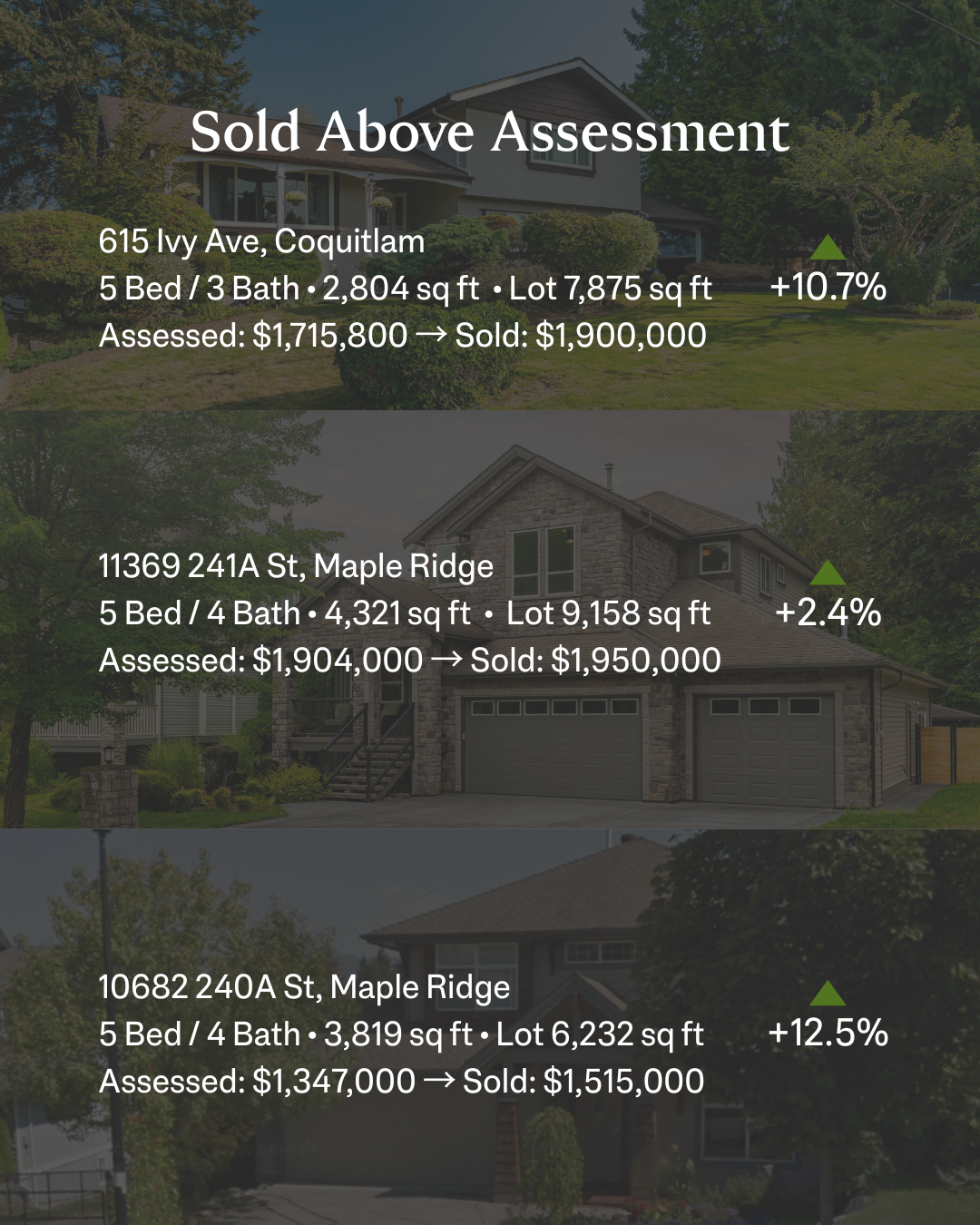 On the other side of the spectrum, several detached homes sold above their assessed values.
For example, 615 Ivy Avenue in Coquitlam sold over assessment because of a combination of unique features, strong buyer interest, and overall desirability. In cases like this, the assessment number becomes almost irrelevant. The market responds to what buyers want, not what a formula predicted months earlier.
When demand is present, especially for detached homes with appealing lot sizes, layouts, or locations, buyers are often willing to pay the price, and prices rise accordingly.
So, Is BC Assessment Wrong?
Not exactly, but it is limited. BC Assessment is:
- Standardized
- Backward-looking
- Designed for taxation purposes
Market value is:
- Dynamic
- Influenced by emotion and competition
- Determined by real buyers in real time
- One is administrative. The other is human.
The Bottom Line
BC Assessment is just one piece of the puzzle. Real market value comes down to:
- Supply and demand
- Buyer interest
- Property type and desirability
- Presentation and positioning
- Strategy and representation
That’s why homes can sell above or below assessment, even when they’re beautiful, well-maintained, and in desirable locations.
If you’re trying to understand what your home is actually worth, or how to price strategically in today’s market, assessment alone won’t give you the full picture. A thoughtful, market-aware approach will.
Jessica Thiele is a Real Estate Advisor with Engel & Völkers Vancouver serving Maple Ridge, Pitt Meadows, and Coquitlam. As a Maple Ridge resident, she helps clients buy and sell homes with clear strategy and local market insight.
Recent Posts